Body fat percentage tells you what your weight is actually made of. Here is how the U.S. Navy circumference method estimates it with a tape measure, what the categories mean, and where the formula’s limits are.
BMI tells you how much you weigh relative to your height. Body fat percentage tells you what that weight is made of. These are fundamentally different questions, and the second one matters more for your health.
The problem is that measuring body fat accurately usually requires expensive equipment — a DEXA scan, hydrostatic (underwater) weighing, or a BodPod. These are precise, but they are also inaccessible for most people. Calipers are cheaper but depend heavily on the skill of the person doing the measurement. None of these are something you can do at home, right now, for free.
That is why we built our Body Fat Calculator around the U.S. Navy circumference method. It requires nothing but a tape measure, and the math behind it is backed by decades of military and research use.
How the Navy method works
The formula was developed in 1984 by researchers James Hodgdon and Margaret Beckett at the Naval Health Research Center in San Diego. Their goal was practical: give the Department of Defense a reliable, field-usable method for assessing body composition across hundreds of thousands of service members without laboratory equipment.
Hodgdon and Beckett compared circumference measurements against underwater weighing (the gold standard at the time) on large samples of Navy men and women. They found that a logarithmic relationship between certain body circumferences and height could predict body fat percentage with reasonable accuracy.
The resulting equations use different inputs for men and women:
For men: Height, waist circumference (at the navel), and neck circumference. The formula calculates the logarithm of the difference between waist and neck measurements, combined with the logarithm of height, to estimate body density — which is then converted to body fat percentage.
For women: The same measurements plus hip circumference. Women carry essential fat differently — in breasts, hips, and pelvis — so the formula accounts for this by including the hip measurement in the equation.
Our calculator implements these exact formulas. When you enter your measurements, the math happening behind the scenes is the same equation the U.S. military has used for over 40 years.
What the categories mean
Once you have a body fat percentage, the question is what to do with it. Our calculator categorizes your result into five ranges based on standards from the American Council on Exercise (ACE):
Men:
- Essential Fat (under 6%) — The minimum fat your body needs for basic organ function, nerve insulation, and hormone production. Not a target — staying here is physiologically unsustainable for most people.
- Athletes (6–14%) — Typical of trained athletes with high muscle mass and low fat. Visible muscle definition. Requires dedicated training and nutrition.
- Fitness (14–18%) — A lean, healthy range achievable with regular exercise and reasonable nutrition. This is where most active, health-focused individuals land.
- Average (18–25%) — The typical range for non-athlete adult men. Not inherently unhealthy, but higher values in this range are associated with increased metabolic risk.
- Obese (25%+) — Elevated body fat associated with significantly increased health risks including cardiovascular disease and type 2 diabetes.
Women:
- Essential Fat (under 14%) — Minimum for hormonal function and reproductive health. Sustained time below this threshold can disrupt menstrual cycles.
- Athletes (14–21%) — Typical of female athletes. Lean with visible definition. Requires consistent training.
- Fitness (21–25%) — A healthy, sustainable range for active women.
- Average (25–32%) — Typical for non-athlete adult women. Within normal physiological range.
- Obese (32%+) — Elevated health risk territory.
The key insight is that men and women have fundamentally different essential fat floors. Women need roughly 10–13% body fat just for basic physiological function, compared to 2–5% for men. This is not a flaw — it is biology, driven by reproductive and hormonal needs.
How to measure accurately
The Navy method is only as good as your measurements. Small errors compound through the logarithmic formula, so technique matters:
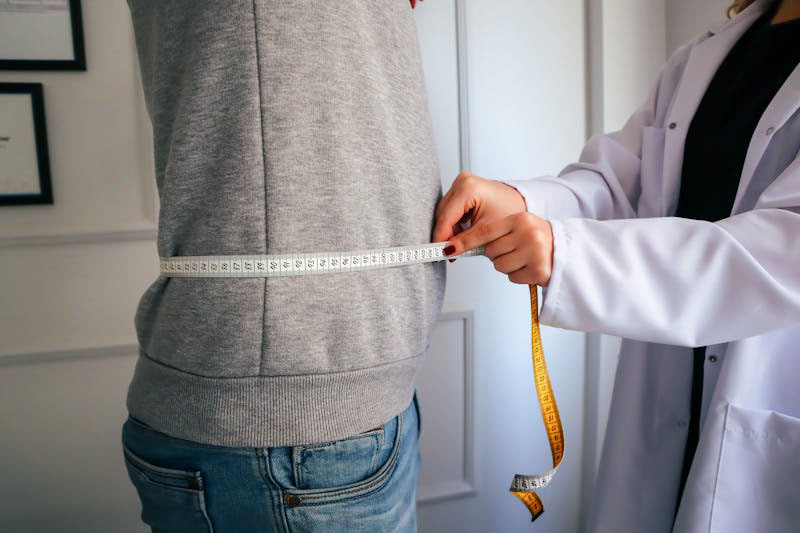
Waist: Measure at the navel, standing relaxed. Do not suck in your stomach — you want a natural reading, not a best-case one. Keep the tape horizontal all the way around.
Neck: Measure just below the larynx (Adam’s apple), with the tape sloping slightly downward at the front. Do not flex your neck.
Hips (women only): Measure at the widest point of the buttocks, keeping the tape horizontal.
General tips: Use a flexible tape measure, not a retractable metal one. Take each measurement twice and average them. Measure at the same time of day (morning is most consistent, before eating). Your trend over weeks matters far more than any single reading — expect ±1–2% normal variation between sessions even at the same actual body fat.
Where the Navy method falls short
No circumference-based formula is as accurate as a DEXA scan or underwater weighing. The Navy method has specific limitations worth understanding:
It estimates, not measures. The formula predicts body fat from correlations between circumferences and body density. Individual variation in fat distribution means two people with identical measurements can have different true body fat percentages.
Muscular individuals may get skewed results. Someone with a thick, muscular neck (like a football lineman or powerlifter) will produce a larger neck measurement, which the formula interprets as less fat — potentially underestimating body fat in people with unusual muscle distribution.
It was developed on military populations. The original validation samples were U.S. Navy and Army personnel — predominantly young, relatively fit adults. Accuracy may decrease for populations that differ significantly from this demographic, including older adults and individuals at very high body fat percentages.
Measurement error is amplified. Because the formula uses logarithms of circumference differences (waist minus neck), even a half-inch measurement error can shift the result by 1–3 percentage points. This is why consistent measurement technique matters so much.
Despite these limitations, the Navy method remains one of the most practical body fat estimation tools available. It is free, requires no equipment beyond a tape measure, and is repeatable enough to track trends over time — which is ultimately more useful than any single reading.
FAQ
How accurate is the Navy body fat method? Studies comparing the Navy method to underwater weighing show it typically estimates within ±3–4% of the true value for most individuals. It is less accurate at very low (<8%) and very high (>35%) body fat percentages. For tracking changes over time, consistency of measurement matters more than absolute accuracy.
What is a healthy body fat percentage? It depends on sex and age. For men, the fitness range (14–18%) and the lower end of average (18–20%) are generally associated with good metabolic health. For women, the fitness range (21–25%) is a healthy, sustainable target. These are general guidelines — individual health markers like blood pressure, blood sugar, and lipid panels matter more than hitting a specific number.
How is body fat different from BMI? BMI uses only height and weight and cannot distinguish muscle from fat. Body fat percentage directly measures (or estimates) the proportion of your weight that is fat tissue. A person with a “normal” BMI can have high body fat, and a person with an “overweight” BMI can have low body fat. Our BMI Calculator and Body Fat Calculator are designed to be used together for this reason.
How often should I measure my body fat? Every 2–4 weeks is sufficient. Body fat does not change quickly — even aggressive dieting produces roughly 0.5–1% change per month. Measuring more frequently than every two weeks mostly captures measurement noise rather than real change.